Recently, I spole with a Boomer friend, who has spent his life immersed in science, engineering, systems, and technological progress. He is passionate about innovation, and isn’t suspicious of technology in the way many people (me!) are becoming these days. If anything, he represents the generation that helped build the modern technological world and genuinely believed that each new layer of advancement would improve human life in meaningful and measurable ways.
That is precisely why his response to a question I asked him really surprised me.
We were talking about artificial intelligence, automation, digital systems, and the increasingly obvious convergence taking place between governments, finance, communication, commerce, education, identity, and machine intelligence. And, the fact that it feels like we are witnessing the construction of an entirely new operating system for civilization.
Layer by layer, a new civilizational architecture is assembling itself around us through digital identity systems, AI-mediated communication, predictive algorithms, biometric integration, cashless economies, automated logistics, smart infrastructure, personalized information streams, and forms of surveillance increasingly normalized through convenience and promises of safety. Even human relationships are becoming progressively mediated through screens, platforms, and machine-curated realities, reshaping how we communicate, perceive one another, and experience the world itself.
A few times during our conversation, he casually reflected, “It’s going to be interesting to sit back and watch this experiment.”
He used the word “experiment” several times.
Deep down, I think many people sense that this is exactly what is happening. Humanity is entering an unprecedented civilizational experiment. This isn’t just another technological transition within an evolving society, but rather a profound environmental transformation of human life itself. We are rapidly constructing a world in which nearly every aspect of our reality is becoming mediated, tracked, digitized, optimized, simulated, or machine-assisted. Our world is a place where the natural rhythms that shaped humanity for thousands of years are steadily being replaced by synthetic rhythms engineered for efficiency, convenience, stimulation, and centralized control.
Most people, though, still speak about technology as if it were a collection of neutral tools sitting on top of our ordinary everday life.
But that framing is becoming dangerously outdated.
Technology is rapidly becoming the only environment humans are permitted to live in. It is becoming the atmosphere inside which modern consciousness itself is being formed.
A child born today enters a world where screens are present before their language fully develops, meaning that their imagination forms under algorithmic influence before they have the maturity to understand what is happening to them. Their social life, education, entertainment, communication, identity, aspirations, fears, desires, and worldview are all increasingly filtered through systems designed to maximize engagement, extraction, predictability, and behavioral influence. The machine is no longer outside us. It is training us from birth.
So eventually I asked my friend what felt like the obvious question.
“So, in your opinion, what’s the alternative?”
He didn’t hesitate.
“Going Amish.”
He said it immediately, almost instinctively, as though somewhere beneath decades of faith in modern progress, he already understood that eventually humanity would arrive at a fork in the road where there would be very little stable ground left in the middle. The great bifurcation is upon us.
I think many people are beginning to sense this now, even if they can’t fully articulate it yet.
“Going Amish” refers to the growing realization that human beings will soon have to make a conscious decision about whether their lives will remain rooted in embodied reality, household life, local interdependence, and the natural rhythms of creation, or whether they will become increasingly absorbed into seamless technological systems that mediate nearly every aspect of existence.
What struck me most about our conversation was the fact that I had already arrived at a remarkably similar conclusion, although through an entirely different path. Over the past several years, the Edenic template for human life has come into increasingly sharp focus for me as I have tried to honestly evaluate the trajectory of modern civilization and the mounting fragmentation surrounding us. The more I have reflected on Scripture, family, health, childhood, community, stewardship, nervous system exhaustion, technological dependence, and the conditions required for genuine human flourishing, the more clearly it has seemed that the Kingdom answer is a return to rightly ordered living.
“Do not be conformed to this world, but be transformed by the renewing of your mind…”
— Romans 12:2
Not escapism, but re-embodiment. Not fear-driven isolation, but the rebuilding of coherent households, meaningful work, living relationship with creation, and deeply rooted communities ordered around Christ rather than systems.
What felt so fascinating to me was realizing that despite our profoundly different worldviews, we had both recognized the same essential truth: the way out of the machine-trap is not political, technological, or ideological. It is civilizational. Human beings must begin recovering the original templates for life on earth that exist outside the machine, or we risk losing touch with the very conditions that make us recognizably human in the first place.
“Going Amish” means that eventually people will have to choose whether they are fundamentally orienting their lives around the machine infrastructure or around embodied human reality (our original design). There will come a point where trying to maintain a deeply human life inside a fully integrated technological system will become virtually impossible.
For a long time, people have assumed there would always be a comfortable middle road available to us. We imagined that we could selectively participate in technological civilization while remaining essentially untouched by its deeper effects.
We believed we could use the systems without being shaped by them.
We were wrong.
The convergence now taking place in our midst changes that equation entirely because the systems themselves are beginning to interlock… banking, communication, identity, work, transportation, medicine, education, commerce, social life, and information are all slowly merging into one cetralized digital ecosystem. The more integrated these systems become, the harder it becomes to meaningfully opt out of any individual layer without experiencing friction across all the others, meaning that eventually we will be forced to be either “all in” or “all out”.
This is why so many people right now are feeling a low-grade psychological pressure building around them even if they can’t fully articulate it… They can sense that participation in the machine is gradually becoming less optional, that the world is reorganizing itself around total integration, and anyone who wishes to live differently is beginning to feel increasingly eccentric, inefficient, inconvenient, or even suspicious.
But what if the instinct to step away isn’t irrational at all? What if it is actually profoundly sane?
Because underneath all the modern technological excitement lies an uncomfortable question that modern civilization rarely asks honestly anymore: what kind of human being is this system producing? What is it actually doing to the human nervous system, the human spirit, the human family, the human body, our attention spans, and our relationship to reality itself?
We are watching the industrialization of human consciousness. My friends, this is the beast system.
People now spend enormous portions of their lives inside environments designed to manipulate their attention, emotions, desires, identity, and perception at scale. Most modern citizens absorb more information in a single week than previous generations encountered in entire months or years, yet much of this information has almost no meaningful connection to our lived reality or actionable responsibility. Human beings are emotionally processing wars, scandals, disasters, ideological battles, celebrity conflicts, social outrage, global fear cycles, economic instability, and algorithmically amplified psychological triggers every. single. day. while sitting physically isolated inside LED-lit homes, disconnected from neighbors, extended family, land, local production, and embodied community life.
This creates a profound form of fragmentation, cuasing the nervous system to remain in a constant state of low-level activation while actual agency steadily declines. People begin confusing observation with participation. They consume the spectacle of civilization “out there” while slowly losing touch with the physical realities that sustain their own actual life.
Meanwhile, many of the very things that have historically made human beings psychologically stable, resilient, and deeply rooted are rapidly disappearing from our modern life. Multi-generational households are increasingly rare, local culture continues to weaken, and many of the shared rituals and rhythms that once held communities together have slowly faded away.
Practical competence is quietly eroding as more and more aspects of ordinary life are outsourced to systems, subscriptions, algorithms, and devices, while children spend less time outdoors in living environments and more time inside digitally mediated ones. Meals, once the natural center of family rhythm and meaningful conversation, have become hurried, distracted, and fragmented by crazy schedules, omin-present screens, and constant interruption. The wisdom of elders is increasingly displaced by algorithmic authority and endless streams of new information, while human attention itself begins to splinter under the relentless pressure of stimulation, urgency, and noise.
Even friendship is changing shape, gradually becoming more performative and transactional as relationships are filtered through curated identities rather than formed through embodied presence, shared work, long conversations, mutual reliance, and years of real life lived together. For many people now, it is entirely normal to spend more time interacting with glowing screens than with wind, water, soil, silence, stars, animals, or unstructured human conversation, despite the fact that these are the very conditions within which human beings were created to flourish.
And yet despite all of this “connection,” loneliness, anxiety, depression, confusion, and meaninglessness continue to rise, rise, rise!
At some point, we have to ask ouselves whether this trajectory represents true advancement at all, because the farther we drift from our Edenic roots and the natural rhythms human beings were designed to live within, the more layers of distortion we seem to normalize as ordinary life.
What we are experiencing is not political frustration or cultural fatigue. I want to suggest that it is biological and spiritual disorientation. Human beings evolved in relationship with living systems. Sunlight. Seasons. Water. Animals. Community. Physical labor. Rhythmic work and rest. Real conversation. Silence. Shared meals. Local responsibility. Interdependence. For nearly all of human history, reality itself was tactile, relational, and embodied. Yet, the modern world increasingly replaces these experiences with abstraction, simulation, speed, and endless cognitive overload.
This is why so many people now fantasize about cabins, farms, villages, gardens, homeschooling, local trade, craftsmanship, and analog beauty.
I believe the body itself is trying to remember how to be human again.
People are beginning to realize that convenience has hidden (and extreme) costs. Every layer of friction removed from life also removes opportunities for competence, patience, cooperation, resilience, and relationship. A civilization built entirely around convenience slowly produces fragile people because difficulty itself is often what creates strength, wisdom, adaptability, and maturity.
The old village structures understood this intuitively. Human beings were meant to belong to actual places. To know who grew their food. To know who built their homes, and who would help them when they became sick or old. To contribute visibly to a living community rather than disappearing anonymously into massive systems.
Modern society promised liberation through hyper-individualism, but what we actually received was isolation. The autonomous consumer became detached from family networks, local economies, natural rhythms, practical production, and increasingly dependent on distant centralized systems for nearly every aspect of survival.
And this kind of machine-dependence reshapes people, fundamentally.
A person who cannot feed themselves, repair anything, educate their children independently, build local relationships, regulate their own attention, or function without digital infrastructure becomes extraordinarily vulnerable during periods of instability. Not merely economically vulnerable, but psychologically vulnerable.
This is why a sovereign future will increasingly belong to those who begin rebuilding small resilient ecosystems of human life now… deeply rooted networks of trust, skill, family, faith, and practical interdependence. Small family compounds (Kinsteads), intentional friendships, shared land projects, local trade networks, homeschooling cooperatives, gardens, workshops, multi-family living, slow craftsmanship, analog education, rhythmic living. Basically, human-scale communities where our children can grow up surrounded by real responsibility, competence, conversation, and people rather than endless digital stimulation.
Many people assume this kind of vision represents a retreat from the future, when in reality it may be one of the only serious attempts to move through what is coming while preserving one’s humanity, inner coherence, and keeping the essential contours of one’s soul intact.
The years ahead will favor those who remain inwardly ordered while the surrounding world becomes increasingly synthetic, fragmented, and destabilized. Scripture says that all creation groans in eager expectation for the revealing of the sons of God, and part of that revealing is the emergence of households and communities that are no longer governed by the nervous, machine-speed rhythms of Babylon, but are re-rooting themselves in wisdom, stewardship, clarity, and living relationship with God, one another, and the created world itself.
The families who learn to cultivate attention, practical competence, emotional steadiness, beauty, hospitality, and local interdependence will become quiet anchors in an age of massive disorientation, preserving forms of human life that are becoming increasingly difficult to sustain within fully mediated technological systems. And most importantly, our children will remember that reality itself still matters; that human beings were not designed to live entirely inside abstraction, stimulation, and machine-managed environments, but in relationship with creation, with one another, and with God.
There is something refreshingly stabilizing about touching living soil after spending years immersed in digital life and endless streams of information. There is something healing about candlelight, long meals around crowded tables, handwritten notes, music played live in a room instead of streamed into isolated ears, our children building forts outdoors, neighbors dropping by unannounced, books with worn pages, repairing objects instead of endlessly replacing them, and slowly learning the kinds of practical skills that reconnect people to the rhythms of the physical world again.
These real, analog things restore coherence between our body, mind, environment, and spirit, helping us recover forms of presence, attentiveness, and wholeness that technological civilization steadily fragments.
I suspect that one of the greatest dangers of the coming technological age is not simply surveillance or automation or AI itself. The deeper danger is that human beings gradually forget what unmediated reality feels like. They may forget the humble textures of slowness, silence, boredom, patience, craftsmanship, contemplation, and real presence, and become so acclimated to synthetic stimulation that ordinary life itself feels insufficient without constant digital augmentation.
And once that threshold is crossed, people become extraordinarily easy to manage because they no longer possess an internal reference point outside the system itself.
This is why getting on the off-ramp now matters.
Take action now from the recognition that once the systems become fully integrated, rebuilding human-scale life will become exponentially more difficult. Practical skills quietly disappear when they are no longer practiced by anyone you know, accessible land steadily concentrates into fewer hands, local community continues to weaken, and human attention becomes increasingly fragmented under constant technological immersion. Over time, dependency on “Babylon” deepens so gradually that most people barely notice it happening, while children raised almost entirely within synthetic environments begin to experience embodied life itself as unfamiliar, and even… uncomfortable.
The families moving toward more analog, land-rooted ways of living are simply trying to preserve enough humanity, enough coherence, and enough living connection to reality that their children will still know how to think clearly, build relationships, care for others, steward creation, and remain spiritually grounded, as the machine-driven world around them becomes unstable, manipulative, psychologically exhausting, or increasingly hostile to fully human life.
“They shall build houses and inhabit them; they shall plant vineyards and eat their fruit.”
— Isaiah 65:21
More and more people are beginning to sense that the ultimate luxury in the years ahead may simply be the ability to remain fully human: spiritually awake, emotionally whole, rooted in reality, capable of wonder, and still deeply connected to God, creation, and one another in a world drifting steadily toward abstraction.
The Oikenes
The more I have reflected on all of this, the more I have come to feel that what is emerging in families returning to the land, rebuilding household economies, and gathering once again in small kin-centered settlements is the gentle stirring of something ancient and deeply human, that was encoded in our bones from Eden itself.
And while there have always been back-to-the-land movements, sustainability communities, off-grid experiments, and forms of nature-centered spirituality seeking escape from modernity, what I am highlight is fundamentally different in both orientation and spirit.
Becuase what I am talking about is not ultimately about environmental ideology, aesthetic homesteading, self-sufficiency as an identity, or a retreat into isolated alternative lifestyles.
It is about the restoration of rightly ordered household life under God; families re-rooting themselves in covenant, stewardship, embodied reality, interdependence, and the rhythms of creation as they intentionally rebuild human-scale ways of living outside the totalizing pull of technocratic culture.
“Every man shall sit under his own vine and under his own fig tree, and no one shall make them afraid.”
— Micah 4:4
I have begun thinking of this emerging parallel culture of Kingdom-rooted families as Oikene Kinsteads, a phrase I made up 🙂 that carries within it the gravity of dwelling in alignment with our design, the memory of covenantal life in Christ, and the deep civilizational rootedness required for the age now unfolding before us.
I wanted to create a term that could carry some of the off-grid, civilization-adjacent qualities people associate with the Amish, without the old-order religiosity or cultural rigidity often attached to it, because what is emerging feels like the formation of something entirely new: an ancient-future expression of Kingdom life taking shape within the conditions of our own age.. I wanted language that could hold the spiritual gravity of households orienting themselves toward the reality of the Kingdom while remaining decentralized, deeply human, and wholly dependent upon Christ rather than institutions, ideologies, or systems to guide them.
Oikene draws from the ancient Greek root oikos, a word used throughout Scripture that carries a meaning far deeper than our modern understanding of “home.” An oikos was an entire living order: family, dwelling, land, stewardship, inheritance, provision, rhythm, economy, memory, and belonging woven together into a coherent whole.
It is the same root concept behind passages speaking of salvation coming to an entire household, revealing how deeply covenantal and multi-generational the biblical vision of LIFE truly was. Long before the rise of massive centralized systems and industrial dependency, the oikos was the fundamental unit of civilization itself! Within it, children were formed, food was cultivated, wisdom was preserved, skills were passed down, elders were honored, worship was practiced, and identity emerged organically through shared life across generations. The household was not a detached refuge from the “real world”; it was the very center of human continuity, responsibility, and Kingdom life.
It is also fascinating that from this single Greek root we eventually inherited both the words ecology and economics. In the modern world, we tend to separate these ideas entirely, but originally they emerged from the same source. Ecology, in its deepest sense, is the study of the household of life itself, the relationships between living things and the environments that sustain them. Economics originally referred to the management of the household, the ordering of resources, relationships, production, and stewardship within the oikos. Both words point back to the same ancient understanding, that healthy life emerges from rightly ordered households living in harmony with reality.
Those of us turning from the machine, back to our original design are the Oikene… the holistic, Kingdom householders returning to the land, to invest in a parallel world outside of the kingdom of this world.
So, in true Bonnie’s Dictionary fashion, here is my latest contribution to the vocabulary of the convergence era:
Oikene (oy-KEEN)
noun
- A Kingdom-rooted way of life centered around the restoration of the household (oikos) as the primary locus of worship, stewardship, education, provision, kinship, and human formation.
- An emerging parallel culture of decentralized families and kinsteads intentionally rebuilding human-scale living through covenantal relationships, local interdependence, embodied rhythms, land stewardship, craftsmanship, hospitality, and spiritual alignment under Christ rather than centralized technological systems.
- A civilizational framework oriented toward dwelling rightly within creation, emphasizing rootedness, multi-generational continuity, practical competence, relational depth, and the preservation of fully human life amid increasing technological abstraction and synthetic mediation.
Etymology:
Coined from the ancient Greek oikos (“household,” “dwelling,” “family order,” “stewardship”) and inspired by oikoumene (“the inhabited world”).Related forms:
Oikene Kinstead — a household or settlement ordered around Kingdom-centered, land-rooted, interdependent living.
Oikenic (adj.) — pertaining to the values, rhythms, or culture of Oikene life.
The Oikene vision is about the recovery of coherence.
It’s the recognition that human beings were not designed to live as fragmented digital units floating inside massive impersonal systems. We were designed for rootedness, stewardship, shared rhythms, multi-generational continuity, and meaningful participation in the maintenance of life itself.
The Oikene household becomes a place where children once again witness Kingdom reality directly instead of merely consuming representations of reality through screens. It becomes a place where our meals matter again, where practical competence matters again, where the elderly remain woven into daily life, where production and beauty return to the home, and where spiritual formation is embedded into ordinary living rather than outsourced to institutions.
This is where the idea of the Kinstead becomes so powerful as well.
The old English root stede or stead referred to a standing place, a dwelling place, a rooted habitation. Combined with kin, the word begins to describe something many people are already intuitively longing for: networks of households intentionally reweaving human life together at a local and relational scale.
Oikene Kinsteads are not isolated survival compounds cut off from the world in fear, hoarding all the things.
They are living settlements of spiritual and physical continuity.
Places where trust, responsibility, memory, craftsmanship, education, food, celebration, grief, and worship can remain embodied and soulful in an age becoming increasingly synthetic and disembodied.
I suspect that in the coming years, many families will slowly realize that the greatest form of wealth will no longer be technological immersion or endless mobility, but durable belonging.
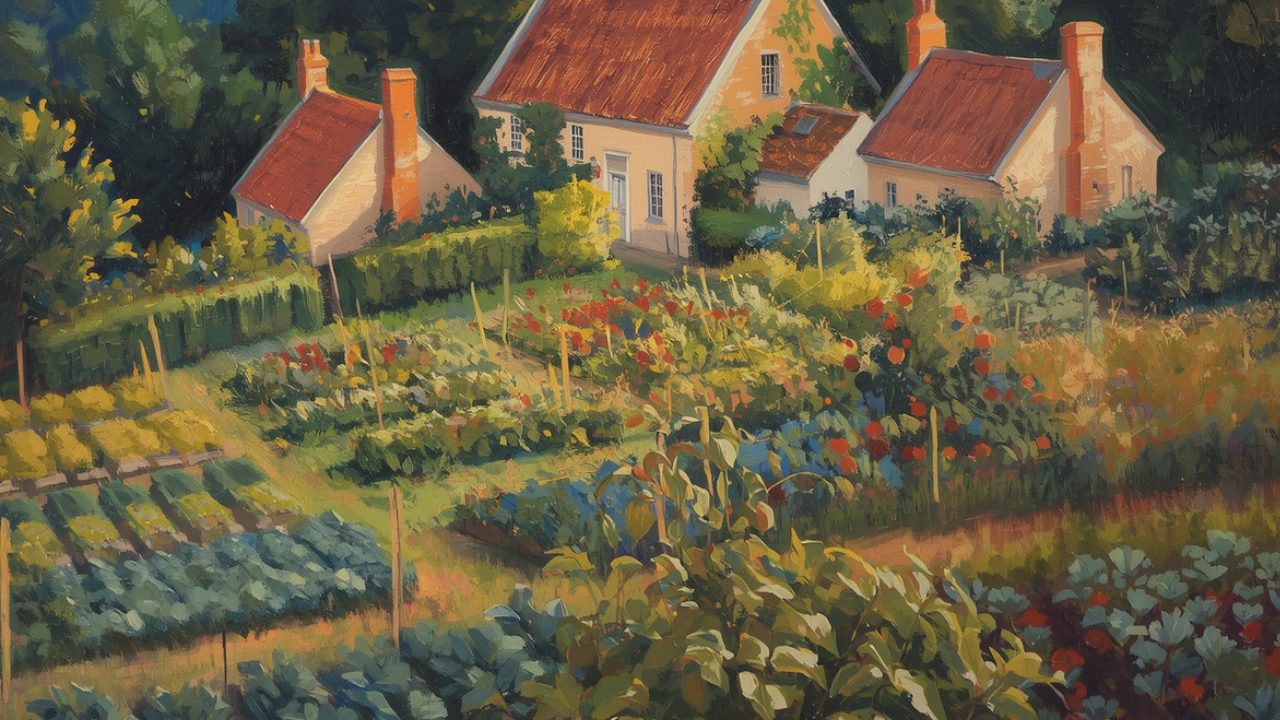
Rambling gardens that know the sound of our voices. Analog homes filled with books, tools, music, bread, conversation, prayer, craftsmanship, and meaningful work. Small villages of families and trusted friends who know one another beyond curated identities and digital projections, sharing life together across seasons, burdens, and celebrations…
The Oikene are not anti-technology, we are simply unwilling to surrender the formation of our children, the integrity of our households, and the sacred architecture of human life to systems that cannot love, and can never truly know what it means to bear the image of God.
I find myself strangely excited to see who God ultimately calls onto this path, because I suspect the emerging Oikene awakening will gather together many people we never would have imagined standing side by side. Some will arrive through faith, others through exhaustion with modern life, others through observing technological convergence firsthand, and still others through an instinctive recognition that something essential in human civilization is slipping away.
We may begin from very different worldviews, vocabularies, and life experiences, yet increasingly arrive at the same realization: that a fully human life cannot survive indefinitely inside systems that continuously fragment attention, sever people from creation, dissolve households, mediate reality itself through machines, and slowly pull human beings out of alignment with the rhythms, relationships, and forms of living that our Creator designed us to flourish within.
That conversation with my boomer friend stayed with me precisely because it revealed this convergence so clearly. Despite our differences, we both recognized the same underlying truth… Somewhere beneath the political narratives, cultural tribes, and generational divides, many people are beginning to sense that the future will require a return to deeper forms of rootedness, embodiment, stewardship, kinship, and spiritual coherence. And perhaps that is part of what makes this moment so fascinating. The Oikene may not emerge from a single ideology, denomination, or movement at all, but from thousands of households quietly awakening to the same ancient memory at the same time.