
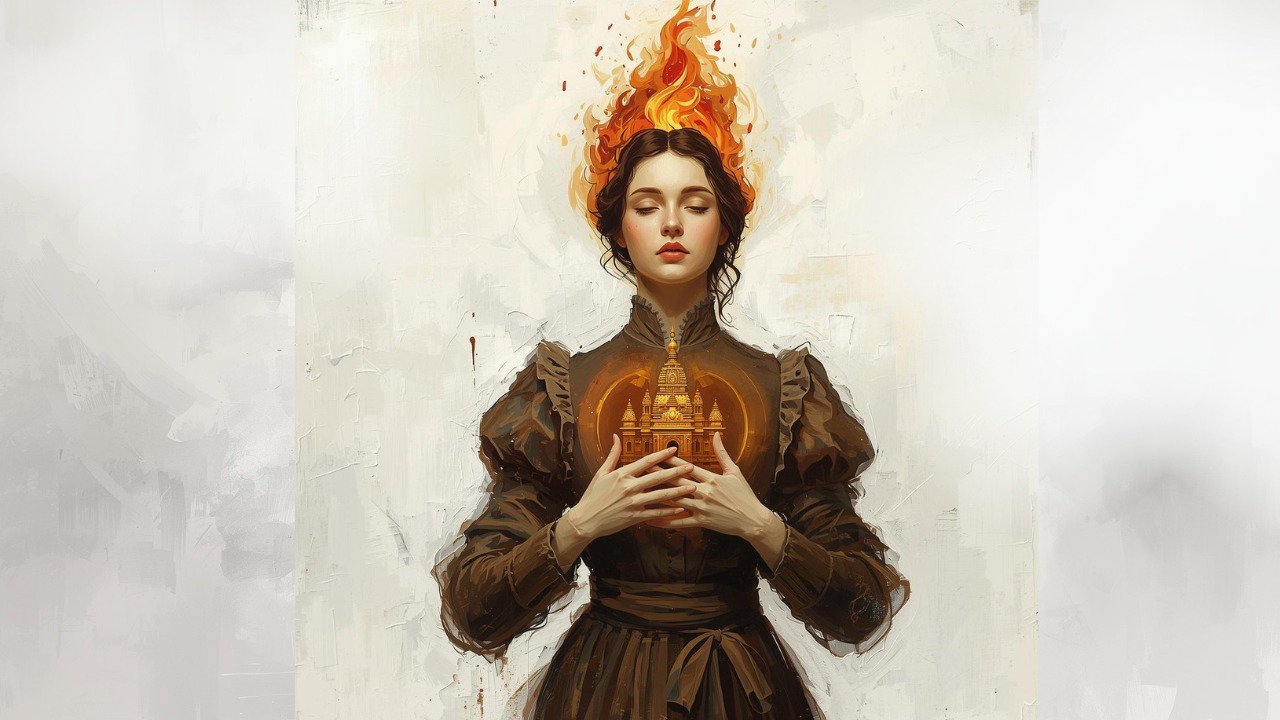
“Therefore when you see the abomination of desolation, spoken of by the prophet Book of Daniel, standing in the holy place, (whoever reads, let him understand), then let those who are in Judea flee to the mountains. Let him who is on the housetop not go down to take anything out of his house. And let him who is in the field not go back to get his clothes…”
-Matthew 24:15
To understand the (let’s be honest) “freaky” phrase “abomination of desolation” used by Jesus here, we have to get out of the mainstream eschatology lane that Christians have been herded into in modern times, and understand that it is not just one thing, but a frequency. We have to let go of the idea that this is just one future moment still on the horizon of our current timeline.
What Jesus is giving us in the Gospel of Matthew 24:15–20 is a pattern to recognize, something living and repeating over cycles of time… a kind of signal embedded in history that tells us when something is going deeply, structurally wrong and requires physical + spiritual alignment to navigate.
At its core, the abomination of desolation is about what happens when a place that was meant to hold God’s presence becomes occupied by something that doesn’t belong there.
The moment something foreign and profaning steps into the space meant for divine indwelling, the impact is immediate and far-reaching, it distorts what was once clear and begins to reshape everything that flows from it.. And when this happens, Jesus calls for immediate discernment and decisive movement from his followers.
When we go back to the roots of this phrase in the Book of Daniel, the word translated “abomination” comes from the Hebrew shiqqûts (שִׁקּוּץ). It carries the sense of something detestable, something that violates and desecrates what is sacred… it is utterly defiling. It speaks of something entering into a space set apart for God and corrupting it by its very presence, introducing disorder where there was meant to be alignment.
In ancient Israel, this was when idols were set up in the temple, pagan altars where they should never have been, and imperial symbols were forced into a place that was meant to reflect heaven. The temple at the time was understood as the meeting point between heaven and earth, the place where God dwelt among His people. So when something alien entered that space it was a tearing of the fabric of Kingdom order itself.
Creation was being bent out of alignment.
I believe that history has already given us the first major fulfillment of this pattern.
In the first century, when Rome surrounded Jerusalem and eventually destroyed the temple, this was the full manifestation of what Jesus had warned about. The holy place was overtaken, and the center of covenant life was breached and dismantled. And the result was desolation, both physically and spiritually.
This marks the end of the old covenant system and the opening into a new phase of Christ’s Kingdom, no longer anchored to a physical temple but carried within His people themselves.
“Do you not know that your body is a temple of the Holy Spirit within you, whom you have from God?” (1 Corinthians 6:19).
The dwelling place of God is no longer confined to stone and geography, but lives and breathes within those who belong to Him, shifting the center of sacred space from a building to your body!
I believe that Jesus’ words here must be understood as part of a prophetic patterning system that Scripture uses repeatedly when speaking about the end of an age. This kind of “end times” language isn’t just linear, where one event happens once at the very end of history, but it is also cyclical and layered, where a real historical fulfillment establishes a template that reappears again in later moments of transition, and then intensifies as history narrows toward its final convergence (our future).
So Christi’s instructions such as “do not go back,” “do not linger,” and “flee” are embedded response codes, given precisely because the pattern they correspond to will emerge more than once. The first-century destruction of Jerusalem provides the initial fulfillment, where those who recognized the signs and acted quickly were preserved, while those who hesitated were caught in the collapse.
This historical moment becomes the prototype.
From this point forward, the same structure repeats whenever a system reaches its point of desecration and destabilization.
This pattern unfolds in recognizable stages:
- First, there is the intrusion of something profane into what was meant to remain ordered under God.
- Second, there is a period where the system still appears outwardly functional, even as its core has been compromised.
- Third, there is a narrowing window where discernment is possible and movement is still available.
- And finally, there is a rapid shift into exposure, collapse, or irreversible transformation.
“End times” language, in this sense, does’t merely describe the final end of all things but the end of specific orders, systems, or ages.
Each “end” carries the same underlying signature, and the instructions attached to it remain consistent because the human tendency to delay, rationalize (normalcy bias), or cling to stability also remains consistent.
Jesus’ command to not return, not linger, and flee reflects an understanding that once the pattern reaches a critical threshold, continued participation in the compromised system is no longer neutral. It becomes entanglement with the beast frequency itself.
As these patterned endings accumulate across history, they begin to converge and compress. So what was once confined to a single place now stretches across regions, then across nations, and now across the systems that organize daily life itself, becoming diffused into the very frameworks we now depend on, shaping our movement, provision, identity, and participation all at once.
This is now unfolding again in a decisive way, as we reach, what I believe is the end of the age.
“When you see all these things, know that it is near—at the doors!”
-Matthew 24:33
Jesus laid out the sequence so it could be clear for us: intrusion leads to desecration, desecration leads to deception, deception leads to pressure, and pressure forces us to make a loyalty decision.
It is this exact pattern that is now surfacing across multiple domains at the same time right now, creating overlapping points of pressure and exposure for people across the earth, as economic systems, social structures, governance models, and communication networks all reach moments where what is truly driving them is being revealed, whether they are aligned with God’s order or work according to the principles of the kingdom of this world.
Remember, the Book of Revelation is ultimately about the revealing of all things.
Okay, so this means that Matthew 24 isn’t just something to study as a future scenario, it is becoming a present-tense reality. The signal Jesus described is appearing in parallel across different areas of our modern life right now, and with that comes a narrowing window for discernment and response.
Our decisions are no longer isolated nor can they easily be delayed without increasing consequence.
Multiple systems are reaching their tipping points at the same time, converging into a moment that carries the same unchanging call to recognize what is unfolding and respond without hesitation.
The Holy Place
Now, the key to clearly understanding the abomination of desolation is to trace what happens to the idea of the “holy place.” Under the old covenant, it was a building. It was geographic and physical. But, with the coming of Jesus, that entire paradigm shifted at the level of reality itself! The dwelling place of God was no longer fixed in stone, but reconstituted within living vessels. It became embodied, relational, and communal all at once. The locus of His Holy presence moved from a structure to a people, from a location to a living field of indwelling!
Meaning… you, we are the house of God!
God’s presence is held, expressed, and multiplied through those who belong to Him. The “church” is no longer something external that one attends, but a living reality that we inhabit and become. The Kingdom is inside of us! (The apostles speak again and again about this reality: that believers themselves are now the temple, that the Spirit dwells within, that the people of God together form a living structure.)
Now, if the holy place isn’t just a building but a people, then the “abomination” is no longer limited to a statue in a temple. It becomes anything that tries to take up residence in that sacred space and reshape it according to a different order. It can happen inside a person through thoughts, loyalties, and patterns that slowly displace what is true, and it can also happen at the level of entire systems, where the structures that organize our lives start to occupy a place of authority that belongs to God alone.
This pattern becomes visible when external systems begin to press into the most basic layers of our identity, access to the things we need for life, as well as our physical bodies.
It can look like digital identity frameworks that become required gateways for buying, traveling, working, or existing in public life, effectively turning participation itself into something granted or withheld by a centralized system (thank you COVID for giving us a preview of this).
It can look like vaccines or technological interventions that are tied to social permission, where our compliance becomes the price of inclusion, or like biometric tracking, implanted or wearable technologies, or data-linked profiles that begin to define who a person is in functional terms, reducing their identity to something scanned and verified.
And it can look like economic systems that restrict our access to money or resources unless a person aligns with certain conditions, making provision dependent on our adherence to the kingdom of this world.
In each case, the physical form is different, but the pattern is the same:. Something external begins to occupy the space of identity, authority, and permission that was only meant to be governed by God.
The “holy place” now reaches into every layer where life is ordered, including how we live, relate, are governed, and how identity is defined.
As the systems around us become more invasive and embedded in our daily functions, even through simple mechanisms like age verification, logins, and identity checks, they begin to control our access to basic participation… this level of integration creates an opening where something external can shift from serving life to (at the flip of a switch) defining it, gradually taking authority over our identity, permission to participate in society, and our belonging in spaces that were never meant to be governed by a machine.
So in this more textured sense, the “abomination” is what happens when something that doesn’t carry God’s order starts to feel completely normal in our every day lives, even necessary (even good!) while quietly replacing what was always meant to be there, a real, living dependence on our Creator.
This frequency of abomination doesn’t show up looking obviously wrong. More likely it will come dressed as efficiency, convenience, or progress. It solves problems and makes life easier. And that is exactly why our discernment matters so much right now, because the shift is subtle, and it happens right at the level of what we really trust and rely on.
The Abomination of desolation is a repeating signal.
There will come a point where that signal intensifies and the window to resist/refuse begins to close, and where staying in your comfort zone becomes participation in what is unfolding. In this moment, the instruction is immediate and clear: do not go back. Do not assume you have more time. Do not trust what still appears stable, because the shift has already happened beneath the surface.
By the time the abomination is visible to the many, the system around it is already deeply compromised, and collapse is already underway.
The abomination marks the shift from what still feels like intensified normal life to the moment when the line is unmistakably drawn, and each person is revealed by where they stand and which kingdom they truly align with. It shows who is discerning the times, and who is willing to change gears when it matters. Some will recognize the pattern and step out, and in doing so find themselves hidden by grace and aligned. Others will linger… just waiting a little bit longer, still settling for what feels familiar… only to become so deeply entangled in collapse that refusal eventually feels impossible.
When Jesus says to flee to the mountains, He isn’t only giving a geographic instruction for his disciples in first-century Judea. He’s revealing a pattern of response.
There are times when the faithful must move away from what is collapsing or corrupted and toward what is still aligned, even if it less established, or less comfortable, or feels too risky, or scares the pants off of us.
God is inviting us deeper.
As our global systems tighten, merge, and come under increased strain, the pull will be to stay in your usual lane, to adjust, to tell yourself it will pass just like it did with COVID (a reflex shaped by normalcy bias and the comfort of the familiar).
These emerging requirements from the system will often feel frustrating but still be somewhat workable, even necessary, sometimes like the only option left. But, the question is what is being stolen from you spiritually, even as you comply physically?
Do the demands of the machine begin to take authority over your identity, decisions, provision, or movement in ways it did not before? Does it start setting the terms of your life, subtly shifting what you rely on and who you obey, until God is no longer at the center?
When this shift happens, a line has been crossed, and our response must be a courageous no. Not for me and my house.
Jesus doesn’t paint the illusion that everything will remain stable enough during times of upheaval to navigate life slowly on our terms.
He cuts through that entirely.
Don’t linger. Do not go back! Do not assume stability.
What this ultimately means is that the “abomination of desolation” is a pattern to recognize as it forms in real time around us. It’s a spiritually discerned shift in seasons when the systems aroud you begin to accelerate and press into the deepest layers of your life, reaching toward your biology, your identity, and the very image of God within you, seeking to redefine who you are and what you are “allowed” to have.
It has already happened in history in a very real way, and it continues to manifest wherever the dwelling place of God, now carried in people and in the structures that shape their lives, is threatened by something foreign taking its place.
We are entering a time where keeping your temple in order, and holding it clear, steady, and aligned in the Kingdom, will be required of you at a level that can no longer be postponed or outsourced. This isn’t about distant events or future movements on a physical temple mount. The end of the age is personal and intimate… revealing each one of us and who we really trust. This is about your life, your body, your decisions, and your allegiance, now and in the days to come.
What you allow, who you align with, and the things you refuse will carry real consequence in the days to come, pressing beyond the comfort we have grown used to navigating in our soft little western lives. It will require a clarity and resolve that cannot be sustained by our past habits or our lust for ease. It will require real trust in the One who said He would provide when we put the Kingdom first.
This is the new math:
Alignment with God’s order + obedience in real time + trust in His provision + willingness to release false security = clarity, provision, and preservation in the convergence
The critical shift in this equation is that provision is no longer secured first and then followed by obedience. In the Kingdom, it moves in the opposite direction.
Alignment comes first.
Obedience follows.
Trust anchors it.
And provision meets you there.
But, what makes this difficult in practice is the subtraction. The removal of our dependence on systems that once felt familiar and stable. Safety, as it has been commonly understood, cannot be the controlling variable anymore.
If safety remains our priority, obedience will always be delayed.
So the “new math” is not actually new. It’s a return to our design:
Seek first the Kingdom, trust the King, obey when it costs, and allow His provision to meet you on the other side of alignment.